









Hikama: Issue 013 is out
Issue 13 of Hikama (2026) includes the following studies and articles: “Silence or Silencing?
HikamaJournals platform of the Arab Center for Research and Policy Studies.
Issue 13 of Hikama (2026) includes the following studies and articles: “Silence or Silencing?
HikamaIssue 21 of Almuntaqa (2026) includes the following studies and articles: “Editor's Note”; “Two Perspectives on the “Us” and Postmodern Thought” (Azmi Bishara); “Sudanese Peace Agreements (1972-2020): The Legacy of State Formation and the Challenges of Sustainability” (Ahmed Ibrahim Abushouk); “Public Right or Economic Commodity?
AlmuntaqaIssue 24 of Ostour for Historical Studies (2026) includes the following studies and articles: ““Styles” of Tunisian Historical Writing and Epistemic and Methodological Turns in the Modern and Contemporary Periods” (Abdelhamid Hénia); “Writing the General History of Tunisia over a Century: Changes and Challenges (1918-2019)” (Mohamed Lazhar Gharbi); “Repercussions of the Ottoman – Russian War (1768–1774) on the Political Situations in Mount Lebanon and the Coast during the Reign of Emir Yusuf Shihab” (Bassem Marwan Fleifel); “Kenitra from the Village to the Douar: The Expansion of the Urban Environment and the Emergence of the Moroccan Proletariat (1912 - 1975)” (Saïd El Bouzidi); “Urban Development of Jerusalem under Jordanian Rule: Narrating the Jerusalem International Airport, 1948-1967” (Mansour Nasasra); “Agricultural Modernization in Independent Morocco: Operation Plow (1957-1962)” (Brahim Aitizzy); “Microstoria” (Jacques Revel); “Moreno Cirillo's Journey to Southern Morocco: A Study of Mentalities, Representations, and Motivations” (Lacen Idbrahim, Bouzid Laghla); “Tunisia: From the Makhzen to the Modern State – Revisiting Mohamed-Salah Mzali's Intellectual Journey” (Khalid Jeddi); “A Workshop on Disseminating Historical Knowledge: A Reading of Fragments d'histoire marocaine: Société et figures du pouvoir by Abdelahad Sebti” (Hamid Titaou); “Gaza Faces History” (Abdelmajid Skhairi).
Ostour for Historical StudiesIssue 56 of Omran for Social Sciences and Humanities (Spring 2026) includes the following studies and articles: “Post-Independence Algerian Protest Movements: Rupture and Continuity” (Nacer Djabi); “The University as a Field of Struggle: Student Protests in Tunisia and Egypt (1968-1973)” (Adnan ElAmine); “Awareness of Otherness between Religion and Utility: Moroccans’ Representations of Sub-Saharan African Migrants” (Aziz Mechouat, Mehdi Jaafar); “When the Sociologist Wears the Historian’s Cloak: Uses of History in Khaldoun Al-Naqeeb’s Analysis of Gulf and Arabian Peninsula Societies” (Abdulrahman Alebrahim); “War by Another Means: The Impasse of Gaza’s Reconstruction After Genocide” (Wadee Alarabeed); “The Teacher in New Sociologies of Education” (Mohammed El Idrissi); “The Wet and the Dry: Traditional Irrigation in Bali and Morocco” (Clifford Geertz); “Current Ecological Trends: An Exercise in Classification and Typology” (Mohamed Hilal Elhassani); “Homo Numericus: The Coming “Civilization”” (Yassine Atana); “Featured Books” (Omran Editorial Board).
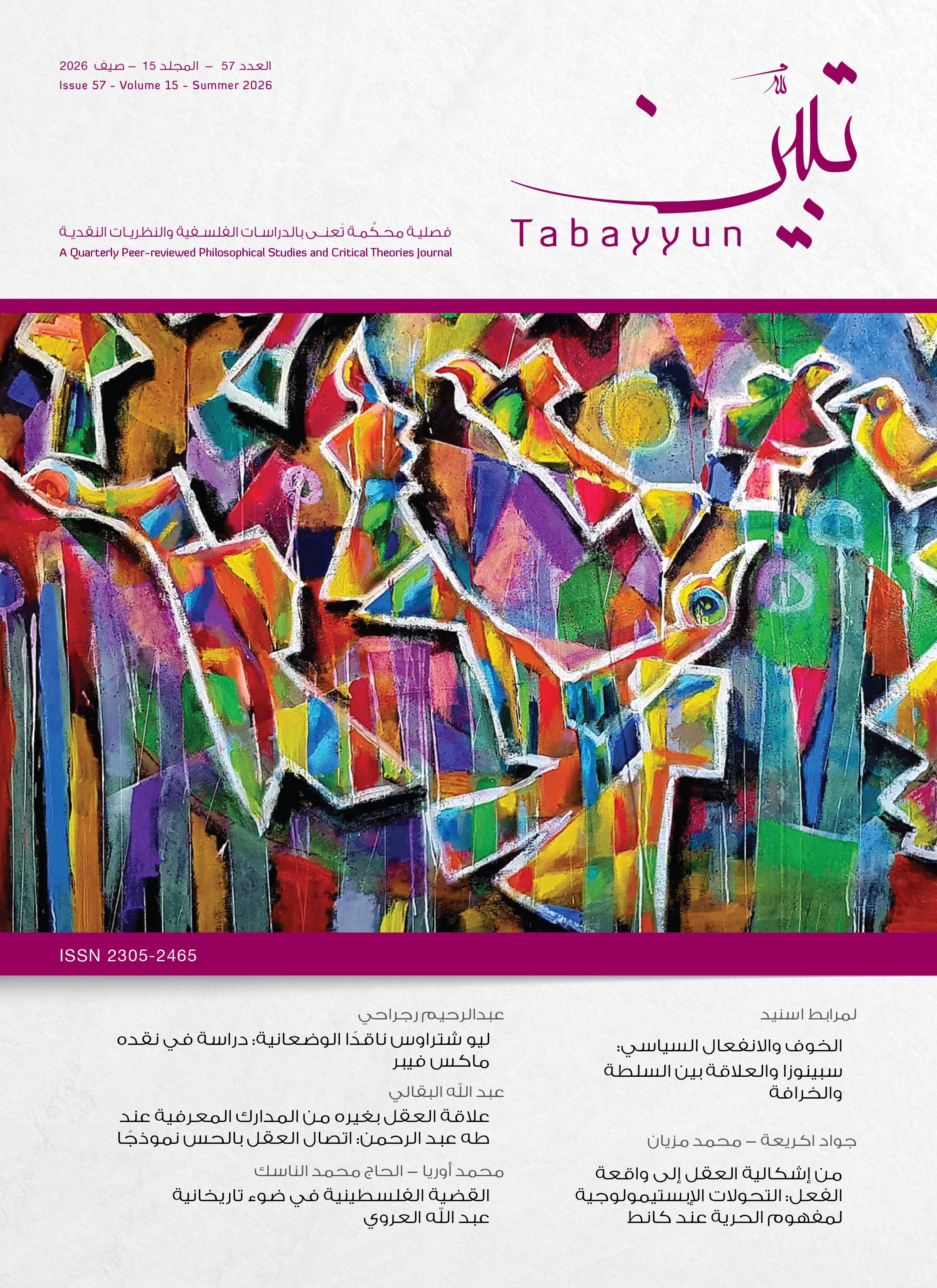
Omran for Social Sciences and HumanitiesIssue 57 of Tabayyun (2026) includes the following studies and articles: “Fear and Political Emotion: Spinoza and the Relationship between Authority and Superstition” (Lemrabott Sneid); “From the Problem of Reason to the Fact of Action: Epistemological Shifts in Kant’s Concept of Freedom” (Jaouad Gria, Mohamed Meziane); “Leo Strauss on Max Weber: His Critique of Positivism” (Abderrahim Rajrahi); “Taha Abdurrahman’s Account of the Connection between Reason and Sense Perception” (Abdellah Bakkali); “The Palestine Question and Abdallah Laroui's Historicism” (El-Hajj Mohamed al-Nassek, Mohamed Ourya); “Abdallah Laroui and Western Culture: Marx and Montesquieu as Pathways to Overcoming Historical Delay” (Soufian EL Barrak); “How Is This Paper Philosophy?” (Kristie Dotson); “The Concept of African Cultural Authenticity: Problematic and Methodological Issues and Other Topics” (Mujahid Eldouma); “The Political in the Ethics of Emmanuel Levinas” (Omar Badri); “Featured Books” (Editorial Board of Tabayyun).
Tabayyunصدر العدد 10 من دورية "استشراف للدراسات المستقبلية"، ويتضمّن الدراسات والمقالات الآتية: "استشراف الطاقة النووية المدنية في الدول العربية في أفق 2040: الجاهزية والمفاضلة بين الخيارات وآفاق التكامل الإقليمي" (موزة بنت محمد الربان)؛ "سيناريوهات التسرب النووي في منطقة الخليج العربي: المخاطر وسبل الوقاية والتعامل معها" (عثمان البهالي، محمد حسن الحجي)؛ "الذكاء الاصطناعي وحروب المستقبل: هل انتهى عصر الردع النووي؟" (عبد الصمد فاضل)؛ "الردع النووي الرمزي في الشرق الأوسط: السيناريوهات الاستراتيجية والتوازنات الإقليمية في أفق 2035" (الدانه عبد الله العماري)؛ "استشراف مستقبلات الطاقة النووية: أربعة مشاهد مستقبلية، عالميًا وعربيًا" (هيئة دورية استشراف للدراسات المستقبلية)؛ "مستقبل الطاقة النووية في سياق السياسات المناخية: السرديات المتنافسة والسيناريوهات الممكنة" (الحسين شكراني، محمد جواد مالزي)؛ "الطريق نحو عصر جديد للطاقة النووية" (وكالة الطاقة الدولية)؛ "سيناريو للحرب النووية" (نجاح عبد الحليم)؛ "النهج النظامي المتكامل في مستقبل الطاقة النووية" (هيئة دورية استشراف للدراسات المستقبلية)؛ "مستقبل البحث العلمي والابتكار في سلطنة عُمان: في ضوء الرؤية المستقبلية" (يوسف بن حمد البلوشي)؛ "تأثيرات الذكاء الاصطناعي 2025-2040: توليف استشرافي قائم على قرائن الاقتصاد السياسي والأنظمة الاجتماعية والتقنية والحوكمة الديمقراطية" (أحمد قاسم حسين)؛ "نحو عالم أكثر مساواة في المستقبل: على الأقل جغرافيًا" (مهدي الأورابي)؛ "الطاقة النووية في الفضاء: رؤية استشرافية (2025-2050)" (هيئة دورية استشراف للدراسات المستقبلية).
Istishraf for Future Studies
This study attempts a detailed discussion of the phenomenon of I’rab (conjugation) between linguistic conventions and relations of proximity through three levels: I’rab and linguistic conventions, I’rab and normative linguistic interaction, and I’rab and the task of communication and expression. The paper argues that the phenomenon of I’rab is related to the two poles of clarification and revelation—clarifying the phonetic signs and revealing the linguistic conventions—in order to fulfill the “manifest” and the “immanent” needs of the speaker, in accordance with the traditions and norms that govern the laws of linguistic communication between this speaker and the listener. The I’rab phenomenon has become rooted in the Arabic language, which means that it did not content to stay faithful to the origins, but went beyond that to investigate the codes of speech by referring phonetics to laws and purposes; thus, the Arabic language is proof of the academic theory that is based on the duality of the conjugated language and the mental structure. In order to employ it in a manner that best serves the Arabic language and its future prospects, this study argues that the I’rab phenomenon is specific to the Arabic language par excellence and that it is not only in need of further investigation, but also a rethinking.
Held by the University of Copenhagen, this conference addressed the changing perspectives in old testament studies. An opening address of around 60 minutes was delivered by Jack Sasson who spoke at length about Mari and our knowledge of the details of life there, including relations between the components of society, archaeological digs, preservation, trade, palace intrigue, and peasant conflicts over irrigation water. The American scholar explained the potential of archaeology to present an expansive image of life in archaeological sites going back 4,000 years. Overall, there was consensus among the conference participants that the conference was constructive, of very high academic standard and that discussions on the papers were conducted according to rigorous academic principles.
This study begins with a historical introduction of the evolution of the “Amazigh question” from the late 1960s to the present, and its role in shaping an individual’s consciousness, culture, history, identity, and awareness of self and surrounding. For some, the Amazigh language has become the essence of the entire Amazigh question. This paper discusses the controversies surrounding the language and the complexities embedded in the question of linguistic identity for the population of the Greater Maghreb. This study is an endeavor to answer questions such as: is Amazigh a single language with different dialects, or is it composed of multiple and different languages that are bound by common traits? Can we even speak of a unified Amazigh language in the context of the great linguistic diversity characterizing the Greater Maghreb? What is behind the oft-repeated calls to standardize and regulate this language in preparation for its unification?
What is history? A question undoubtedly arduous to answer, but the task of solving and explicating it is undertaken by researcher Qais Madi Ferro in this book. Over four chapters, he reviews the methods, schools, and tools that have dealt with this field of knowledge, which covers many contexts and times, given the fact that history in an idea that combines current reality and events in the past, and a method that combines facts and reorders then in imagined images to construct a narrative that describes what happened at a time absent from the human present.
It should be known that language, as the term is customarily used, is the expression by a speaker of his intention. Such expression is an act of the tongue which originates in an intention to convey the meaning of speech. Therefore, language must become an established habit located in the part of the body that produces it, namely, the tongue. In every nation, the formation of language takes place according to their own terminology. The linguistic habit that the Arabs obtained in that way is the best there is. It is the one most clearly expressing the intended meaning, since many ideas are indicated in it by something else than words. There are, for instance, vowels to distinguish the subject from object and i-case – that is, the genitive – and there are letters to transform actions (verbs) – that is, motions – into essences, without need of other words.
The main concern of this book focuses on the attempt to unify the methodological tools that have accumulated over the past six decades for discussing the subject of communications/media, or more accurately, to investigate the theory of media in the knowledge tradition produced around the media since it took on a central place in the reproduction of political and social structures, that is since World War II.
When dealing with Kamal Salibi’s research contribution to the field of the modern and contemporary history of Lebanon, I am struck as a reader and researcher in this field, by two main issues that he dealt with in all his books and articles on Lebanese history over the years. The first issue concerns the Lebanese emirate, whose problem is apparent when the following question, an exceptionally problematic question, is posed: Did this emirate have any special feature or features to give it enough specificity to justify saying that it was the historical form or the historical nucleus that founded or paved the way for the modern Lebanese state? And that the founding hero was Fakhreddin al-Maani? Kamal Salibi reached his view via empirical research in the sources, namely that he does not see any basis for this specificity.









