









Hikama: Issue 013 is out
Issue 13 of Hikama (2026) includes the following studies and articles: “Silence or Silencing?
HikamaJournals platform of the Arab Center for Research and Policy Studies.
Issue 13 of Hikama (2026) includes the following studies and articles: “Silence or Silencing?
HikamaIssue 21 of Almuntaqa (2026) includes the following studies and articles: “Editor's Note”; “Two Perspectives on the “Us” and Postmodern Thought” (Azmi Bishara); “Sudanese Peace Agreements (1972-2020): The Legacy of State Formation and the Challenges of Sustainability” (Ahmed Ibrahim Abushouk); “Public Right or Economic Commodity?
AlmuntaqaIssue 24 of Ostour for Historical Studies (2026) includes the following studies and articles: ““Styles” of Tunisian Historical Writing and Epistemic and Methodological Turns in the Modern and Contemporary Periods” (Abdelhamid Hénia); “Writing the General History of Tunisia over a Century: Changes and Challenges (1918-2019)” (Mohamed Lazhar Gharbi); “Repercussions of the Ottoman – Russian War (1768–1774) on the Political Situations in Mount Lebanon and the Coast during the Reign of Emir Yusuf Shihab” (Bassem Marwan Fleifel); “Kenitra from the Village to the Douar: The Expansion of the Urban Environment and the Emergence of the Moroccan Proletariat (1912 - 1975)” (Saïd El Bouzidi); “Urban Development of Jerusalem under Jordanian Rule: Narrating the Jerusalem International Airport, 1948-1967” (Mansour Nasasra); “Agricultural Modernization in Independent Morocco: Operation Plow (1957-1962)” (Brahim Aitizzy); “Microstoria” (Jacques Revel); “Moreno Cirillo's Journey to Southern Morocco: A Study of Mentalities, Representations, and Motivations” (Lacen Idbrahim, Bouzid Laghla); “Tunisia: From the Makhzen to the Modern State – Revisiting Mohamed-Salah Mzali's Intellectual Journey” (Khalid Jeddi); “A Workshop on Disseminating Historical Knowledge: A Reading of Fragments d'histoire marocaine: Société et figures du pouvoir by Abdelahad Sebti” (Hamid Titaou); “Gaza Faces History” (Abdelmajid Skhairi).
Ostour for Historical StudiesIssue 56 of Omran for Social Sciences and Humanities (Spring 2026) includes the following studies and articles: “Post-Independence Algerian Protest Movements: Rupture and Continuity” (Nacer Djabi); “The University as a Field of Struggle: Student Protests in Tunisia and Egypt (1968-1973)” (Adnan ElAmine); “Awareness of Otherness between Religion and Utility: Moroccans’ Representations of Sub-Saharan African Migrants” (Aziz Mechouat, Mehdi Jaafar); “When the Sociologist Wears the Historian’s Cloak: Uses of History in Khaldoun Al-Naqeeb’s Analysis of Gulf and Arabian Peninsula Societies” (Abdulrahman Alebrahim); “War by Another Means: The Impasse of Gaza’s Reconstruction After Genocide” (Wadee Alarabeed); “The Teacher in New Sociologies of Education” (Mohammed El Idrissi); “The Wet and the Dry: Traditional Irrigation in Bali and Morocco” (Clifford Geertz); “Current Ecological Trends: An Exercise in Classification and Typology” (Mohamed Hilal Elhassani); “Homo Numericus: The Coming “Civilization”” (Yassine Atana); “Featured Books” (Omran Editorial Board).
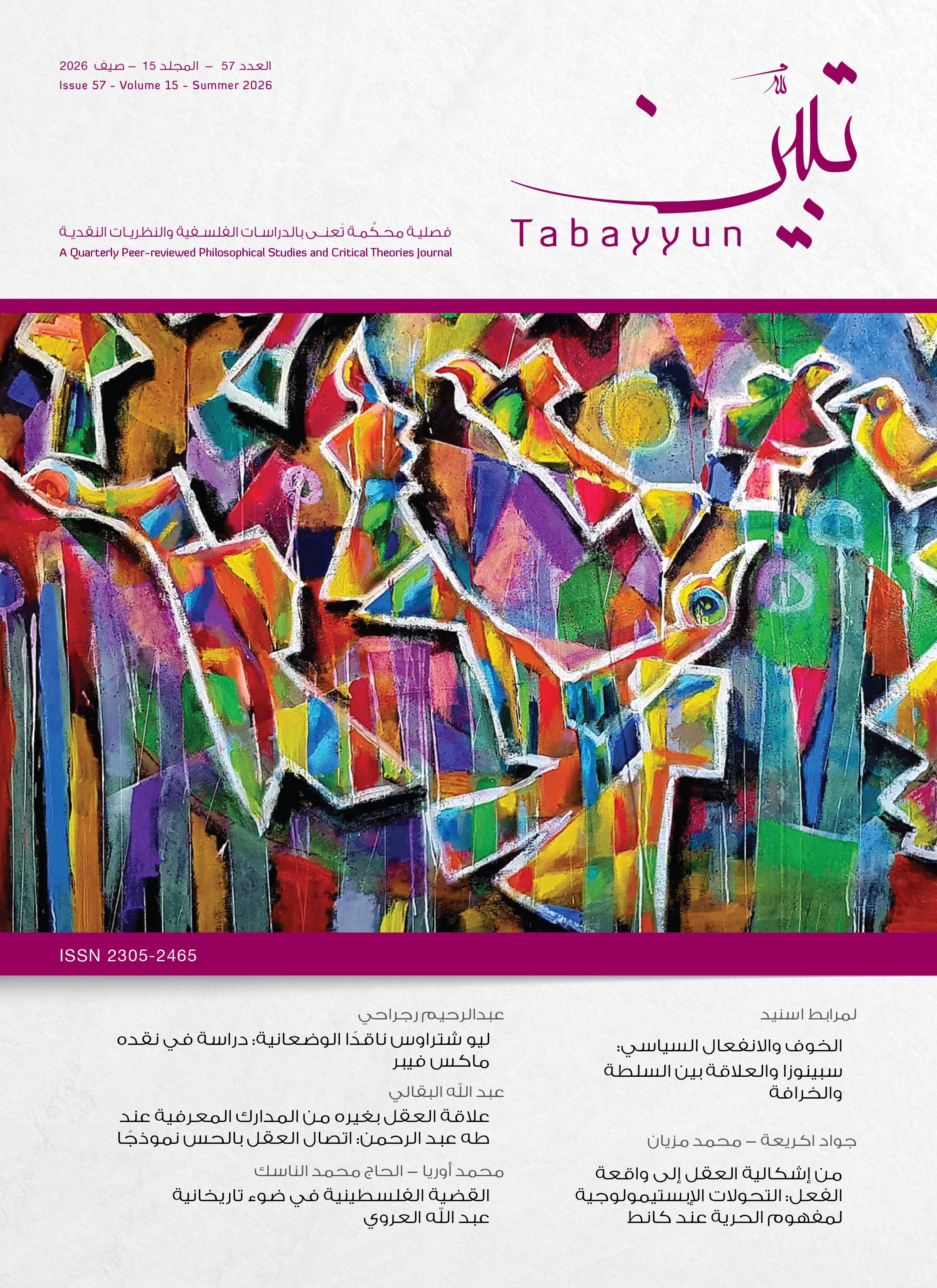
Omran for Social Sciences and HumanitiesIssue 57 of Tabayyun (2026) includes the following studies and articles: “Fear and Political Emotion: Spinoza and the Relationship between Authority and Superstition” (Lemrabott Sneid); “From the Problem of Reason to the Fact of Action: Epistemological Shifts in Kant’s Concept of Freedom” (Jaouad Gria, Mohamed Meziane); “Leo Strauss on Max Weber: His Critique of Positivism” (Abderrahim Rajrahi); “Taha Abdurrahman’s Account of the Connection between Reason and Sense Perception” (Abdellah Bakkali); “The Palestine Question and Abdallah Laroui's Historicism” (El-Hajj Mohamed al-Nassek, Mohamed Ourya); “Abdallah Laroui and Western Culture: Marx and Montesquieu as Pathways to Overcoming Historical Delay” (Soufian EL Barrak); “How Is This Paper Philosophy?” (Kristie Dotson); “The Concept of African Cultural Authenticity: Problematic and Methodological Issues and Other Topics” (Mujahid Eldouma); “The Political in the Ethics of Emmanuel Levinas” (Omar Badri); “Featured Books” (Editorial Board of Tabayyun).
Tabayyunصدر العدد 10 من دورية "استشراف للدراسات المستقبلية"، ويتضمّن الدراسات والمقالات الآتية: "استشراف الطاقة النووية المدنية في الدول العربية في أفق 2040: الجاهزية والمفاضلة بين الخيارات وآفاق التكامل الإقليمي" (موزة بنت محمد الربان)؛ "سيناريوهات التسرب النووي في منطقة الخليج العربي: المخاطر وسبل الوقاية والتعامل معها" (عثمان البهالي، محمد حسن الحجي)؛ "الذكاء الاصطناعي وحروب المستقبل: هل انتهى عصر الردع النووي؟" (عبد الصمد فاضل)؛ "الردع النووي الرمزي في الشرق الأوسط: السيناريوهات الاستراتيجية والتوازنات الإقليمية في أفق 2035" (الدانه عبد الله العماري)؛ "استشراف مستقبلات الطاقة النووية: أربعة مشاهد مستقبلية، عالميًا وعربيًا" (هيئة دورية استشراف للدراسات المستقبلية)؛ "مستقبل الطاقة النووية في سياق السياسات المناخية: السرديات المتنافسة والسيناريوهات الممكنة" (الحسين شكراني، محمد جواد مالزي)؛ "الطريق نحو عصر جديد للطاقة النووية" (وكالة الطاقة الدولية)؛ "سيناريو للحرب النووية" (نجاح عبد الحليم)؛ "النهج النظامي المتكامل في مستقبل الطاقة النووية" (هيئة دورية استشراف للدراسات المستقبلية)؛ "مستقبل البحث العلمي والابتكار في سلطنة عُمان: في ضوء الرؤية المستقبلية" (يوسف بن حمد البلوشي)؛ "تأثيرات الذكاء الاصطناعي 2025-2040: توليف استشرافي قائم على قرائن الاقتصاد السياسي والأنظمة الاجتماعية والتقنية والحوكمة الديمقراطية" (أحمد قاسم حسين)؛ "نحو عالم أكثر مساواة في المستقبل: على الأقل جغرافيًا" (مهدي الأورابي)؛ "الطاقة النووية في الفضاء: رؤية استشرافية (2025-2050)" (هيئة دورية استشراف للدراسات المستقبلية).
Istishraf for Future Studies
In his book The Epistemological Foundations for Linguistic Theory Mohammed al-Amri debates epistemological theories with the aim of deconstructing the foundations of discourse and the episteme of contemporary linguistics, upon which major theories of linguistics are based. His findings aim to challenge the cognitive specifics of modern linguistics. Dr al-Amari is professor at the Faculty of Literature and Humanities at Cadi Ayyad University, Marrakesh, Morocco. He is a researcher in linguistics specializing in the epistemology of the discourse of contemporary linguistics.
Philosophy may have begun when people started thinking about the beginning—or the arché, as the pre-Socratics teach us—but it is equally probable that such reflections were inspired by the realization that things have not just a beginning, but also an end. The classic example of a syllogism and therefore of an unshakeable argument is “All men are mortal, Socrates is a man, therefore Socrates is mortal.” That Socrates is mortal is the result of an inference, but that all men are mortal is a premise you cannot argue with. In the course of history, many “incontrovertible truths” (that the sun revolves around the Earth, that there is such a thing as spontaneous generation, that the philosophers’ stone exists) have been called into doubt, but not the fact that men are mortal. At most, the faithful believe that one man rose again, but before that happened, he had to die first.
This study takes up Tammam Hassan’s critique of the I‘rāb (inflection) theory, which the late Arabic linguist attempted to replace with his notion of “combined evidence” as a “new alternative”: a system of linguistic structures that articulate discourse, wherein the whole should always be seen in light of context. In other words, each illuminating contextual detail or clue contributes to the derivation of the overall functional and grammatical meaning. The “new alternative”, with its synergies of evidence and its interactive overlapping levels of meaning, enabled the discovery of the foundations of a new grammatical methodology. Inflection provides one of many strands of linguistic evidence, clues that reveal the functional meaning of the sequences of enunciation comprising structural or compositional pattern. But it is incapable of doing so alone or in isolation from contextual indications. The inflective ending of an Arabic word does not have the power, in Tammam Hassan’s view, to explain grammatical phenomena and contextual relationships; as linguistic evidence it may be considered to be among the major signs of interpretive exaggeration and insufficiently rigorous scrutiny. The study in hand, however, considers the new alternative to be in essence an elaboration of the classical I‘rāb theory.
With regard to the Arab world, it is surprising to see that in fact literature written in French, which was thought to be linked with the colonial moment and destined to disappear post-independence with the Arabization policies adopted at that period, has seen a new flourishing starting in the 1980s. I am not referring just to the production of Arab émigré writers in France, such as Tahar Ben Jelloun and Driss Chraïbi, but also to literary works in French by authors living in their own countries who publish in French, whether for a small elite of readers or for the majority of readers in their home countries.
This study considers the Algiers Declaration (1988), which provided a basis for the establishment of the State of Palestine, highlighting its enfranchising character as political oration. In addition to the lexical and structural ingredients typically discussed by classical studies, this type of political discourse is subject to the problematic of international relations and the realm of power. It creates a space for the interaction of selves (Palestinian and, or with, others) and intentions (strategies advocating liberation).The Algiers Declaration is unique for its distinctive oratory, produced in defense of the solid and eternal connection of human beings to land, as well as the legitimacy of building a homeland for the present generation and struggling generations to come. A specific strategy is followed, in the articulation of the declaration, to establish the thesis and persuade the recipient to adopt the perspective embodied in Palestinian and international public opinion. The declaration deploys history, creative imagination, utopian vision, ideology, symbolic edifices and other mechanisms to sustain a continuity of struggle, with rhetorical gears meshing and urging action towards liberation and emancipation. The author invests the devices of rhetorical semiotics to analyze the key components of the speech’s structure and organization, as well as the techniques used to convey the vision and convince the recipient of intentions that transcend the structural bounds of the oration.
Al- Masawi provides a critical reading of the concept of freedom in contemporary Islamic thought and provides a close reading of the contemporary output of Islamic political thought and the most important writing done on the concept of freedom. The paper is premised on the notion that religious texts in Islam incorporate many principles and ideas that essentially converge with the concept of freedom. This is what prompted a number of Islamic scholars (ulama’) and leaders of Islamic political movements to draft the “Universal Declaration of Human Rights in Islam”, as declared by the World Islamic Council in Paris, on September 19, 1981 – a declaration which summarized much of the literature attempting to formulate the idea of human rights in the Islamic system. The religious texts of the Quran and the Sunnah enabled these thinkers to find Islamic roots for many of the rights and freedoms universally recognized in the Universal Declaration, but a problem remained: how could one determine when or if the bounds of acceptable ijtihad – juristic interpretation – had been exceeded? This paper offers an in-depth discussion on the natural concept of freedom and the ways in which contemporary Islamic thought has debated it, taking various stands regarding civil and political rights, in the framework of the political community.
Fouad Makhoukh discusses the problem of determinism and freedom in history, as addressed by the German philosopher Ernst Cassirer and as seen in his response to a series of philosophical conceptions (positivist, Hegelian, Spenglerian). Proponents of these notions defended determinism as a key concept for the study of historical facts, as opposed to affirming mankind’s freedom and ability to make history. In his analysis of this problematic, Cassirer presents such conceptions in order to go beyond them, drawing inspiration from the Kantian philosophy of history and the human effectiveness of liberation self-realization, achieving self-consciousness. Cassirer takes a stand on freedom in history, in particular, and more generally towards culture and the sciences, through negating the possibility of defining culture based upon the concept of “necessity,” and emphasizing rather the concept of “freedom” in its ethical sense: mankind is the maker of history, enjoying undeniable autonomy and the ability to act and produce cultural forms, at specific historical intervals.









