

Changes in the methods and tactics of terrorist groups have triggered continuous and permanent legislative change nationally and internationally.

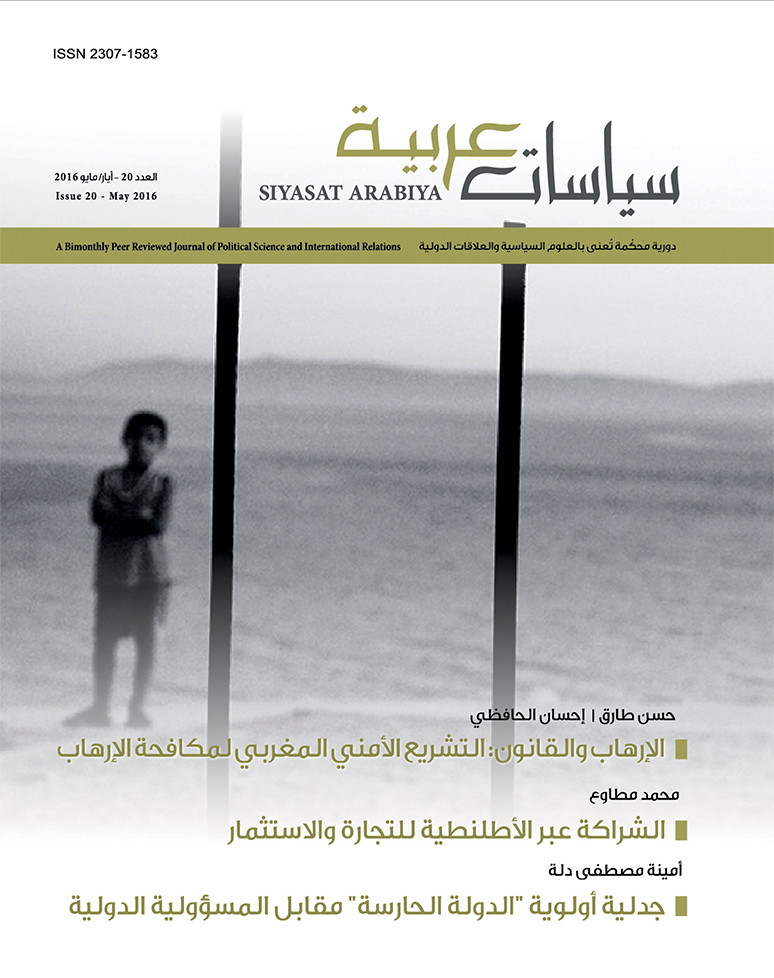
ACRPS has published issue 20 of the bi-monthly peer-reviewed academic journal Siyasat Arabia, a journal devoted to political science and international relations. This issue includes the following studies and analytical papers: “Terrorism and the Law: Moroccan Anti-Terror Legislation” (Hassan Tarek and Ihsan al-Hafezi); “The Debate over the Precedence of ‘the Guardian State’ or of State Responsibility: an Investigation into the Principle of Solidarity with Regard to Arab Specifics” (Amina Mostefa Della); Questions of Parliamentary Monarchy in the Moroccan Constitutional System” (Abdelilah Essatte); “Transatlantic Partnership for Trade and Investment: An Economic NATO with Geostrategic Motives” (Mohamed Metawe); “The Refugee Crisis in the Arab World and its Domestic and Regional Implications” (Alaa Abdelhafiz); and “Iranian Infiltration in East Africa and its Implications for Gulf National Security 2002-2014” (Ali Metwally Ahmed). The section on the AOI includes a paper prepared by the Arab Opinion Unit at ACRPS entitled, “Arab Public Opinion on the Performance of Parliaments according to the Results of the 2015 AOI”.There are also reviews of important books: Ahmad Qassem Hussein’s review of International Relations Theories: Discipline and Diversity by Tim Dunne et al.; Mohamed Ali Nador and Morsi Mochiri’s review of “Algerian Security Policy: Determinants, Fields and Challenges” by Mansour Lakhdari; Ahmad Jassim al-Hussein’s review of La Fabricaccion de l’ennemie [the Making of an Enemy] by Pierre Conesa; and Hikmat Abdul Rahman’s review of Les ondes de choc des révolutions arabes (Shock Waves Generated by the Arab Revolutions) by Chantal Verdeil et al. The journal also includes the two regular sections covering the most important milestones of democratic transformation in the Arab world and events in Palestine during March and April 2016.
The opinions expressed by the authors do not necessarily reflect the positions held by the "Arab Center for Research and Policy Studies," the "Doha Institute for Graduate Studies," or the journal "Siyasat Arabiya."
Changes in the methods and tactics of terrorist groups have triggered continuous and permanent legislative change nationally and internationally.
The changing structure of International Law has always been a contentious issue because of the analytical and practical contradictions imposed by the concept of Solidarity whether its international or humanitarian sense.
The referendum on the new Moroccan constitution in July 2011, which varied readings and perspectives around it, between supporters of the methodology and implications brought as necessary step towards democracy.
US and European Union officials began discussions on the formation of the Trans-Atlantic Trade and Investment Partnership (TTIP) in July, 2013.
This paper discusses the escalation of the refugee crisis following the revolutions of the Arab Spring, which triggered a mass exodus of people fleeing the countries witnessing revolution, including Syria.
Interest Iranian foreign policy in Africa could be treat back to the sixties of the last twentieth century, when African states attained their independence.
Findings from the Arab Opinion Index show that the Arab public has broadly negative views of the performance of their countries’ legislative councils.
This report highlights some of the major milestones of the Arab democratic transition. The countries covered include Tunisia, Egypt, Libya,Syria and Yemen.
This report chronicles some of the most significant developments relating to the Arab-Israeli conflict.
International Relations Theories: Discipline and Diversity [Translated into Arabic]
Algerian Security Policy: Determinants, Fields and Challenges [Arabic]
La Fabricaccion de l’ennemie [Translated into Arabic]








