









Hikama: Issue 013 is out
Issue 13 of Hikama (2026) includes the following studies and articles: “Silence or Silencing?
HikamaJournals platform of the Arab Center for Research and Policy Studies.

Issue 13 of Hikama (2026) includes the following studies and articles: “Silence or Silencing?
HikamaIssue 21 of Almuntaqa (2026) includes the following studies and articles: “Editor's Note”; “Two Perspectives on the “Us” and Postmodern Thought” (Azmi Bishara); “Sudanese Peace Agreements (1972-2020): The Legacy of State Formation and the Challenges of Sustainability” (Ahmed Ibrahim Abushouk); “Public Right or Economic Commodity?
AlmuntaqaIssue 24 of Ostour for Historical Studies (2026) includes the following studies and articles: ““Styles” of Tunisian Historical Writing and Epistemic and Methodological Turns in the Modern and Contemporary Periods” (Abdelhamid Hénia); “Writing the General History of Tunisia over a Century: Changes and Challenges (1918-2019)” (Mohamed Lazhar Gharbi); “Repercussions of the Ottoman – Russian War (1768–1774) on the Political Situations in Mount Lebanon and the Coast during the Reign of Emir Yusuf Shihab” (Bassem Marwan Fleifel); “Kenitra from the Village to the Douar: The Expansion of the Urban Environment and the Emergence of the Moroccan Proletariat (1912 - 1975)” (Saïd El Bouzidi); “Urban Development of Jerusalem under Jordanian Rule: Narrating the Jerusalem International Airport, 1948-1967” (Mansour Nasasra); “Agricultural Modernization in Independent Morocco: Operation Plow (1957-1962)” (Brahim Aitizzy); “Microstoria” (Jacques Revel); “Moreno Cirillo's Journey to Southern Morocco: A Study of Mentalities, Representations, and Motivations” (Lacen Idbrahim, Bouzid Laghla); “Tunisia: From the Makhzen to the Modern State – Revisiting Mohamed-Salah Mzali's Intellectual Journey” (Khalid Jeddi); “A Workshop on Disseminating Historical Knowledge: A Reading of Fragments d'histoire marocaine: Société et figures du pouvoir by Abdelahad Sebti” (Hamid Titaou); “Gaza Faces History” (Abdelmajid Skhairi).
Ostour for Historical StudiesIssue 56 of Omran for Social Sciences and Humanities (Spring 2026) includes the following studies and articles: “Post-Independence Algerian Protest Movements: Rupture and Continuity” (Nacer Djabi); “The University as a Field of Struggle: Student Protests in Tunisia and Egypt (1968-1973)” (Adnan ElAmine); “Awareness of Otherness between Religion and Utility: Moroccans’ Representations of Sub-Saharan African Migrants” (Aziz Mechouat, Mehdi Jaafar); “When the Sociologist Wears the Historian’s Cloak: Uses of History in Khaldoun Al-Naqeeb’s Analysis of Gulf and Arabian Peninsula Societies” (Abdulrahman Alebrahim); “War by Another Means: The Impasse of Gaza’s Reconstruction After Genocide” (Wadee Alarabeed); “The Teacher in New Sociologies of Education” (Mohammed El Idrissi); “The Wet and the Dry: Traditional Irrigation in Bali and Morocco” (Clifford Geertz); “Current Ecological Trends: An Exercise in Classification and Typology” (Mohamed Hilal Elhassani); “Homo Numericus: The Coming “Civilization”” (Yassine Atana); “Featured Books” (Omran Editorial Board).
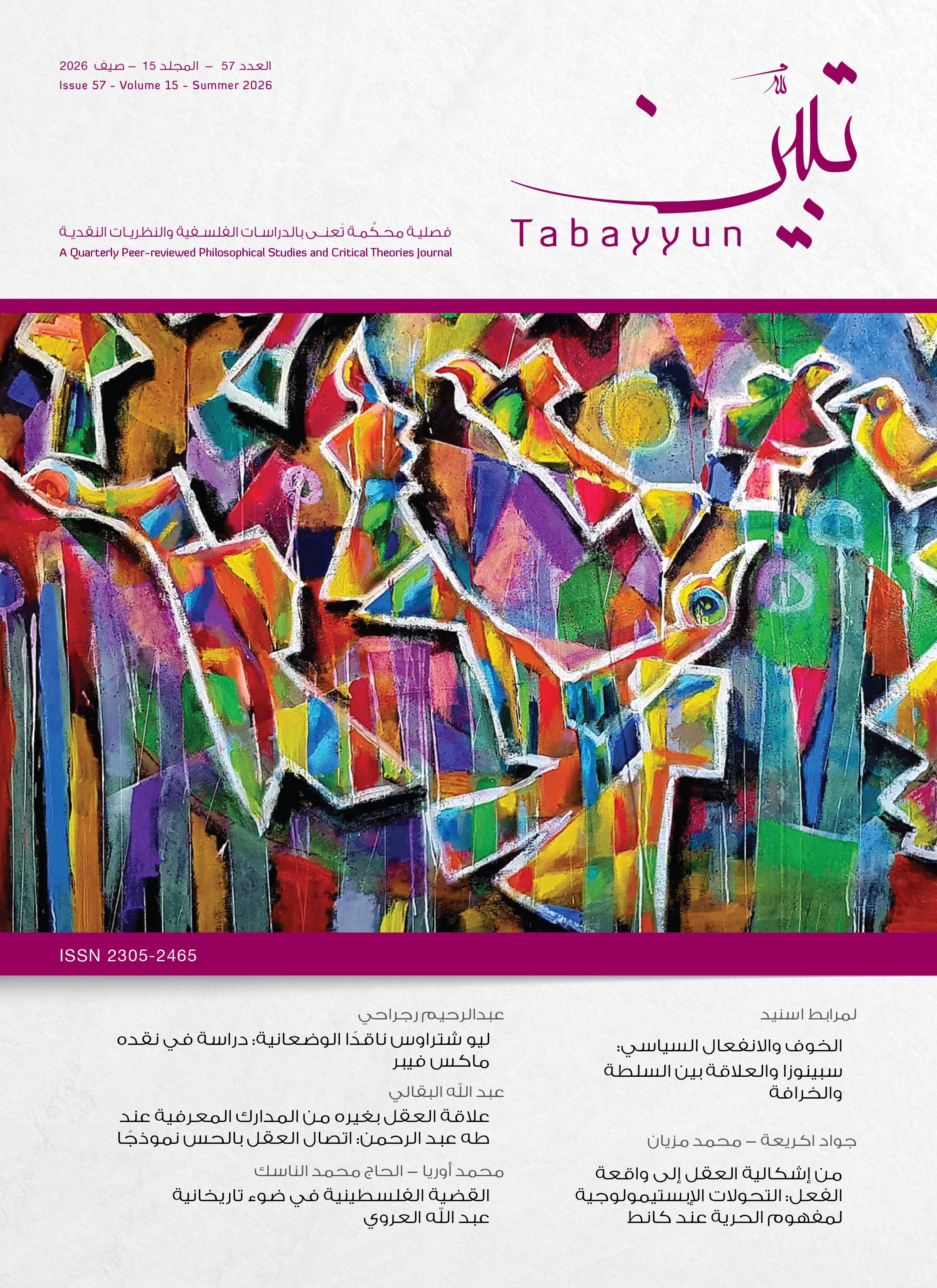
Omran for Social Sciences and HumanitiesIssue 57 of Tabayyun (2026) includes the following studies and articles: “Fear and Political Emotion: Spinoza and the Relationship between Authority and Superstition” (Lemrabott Sneid); “From the Problem of Reason to the Fact of Action: Epistemological Shifts in Kant’s Concept of Freedom” (Jaouad Gria, Mohamed Meziane); “Leo Strauss on Max Weber: His Critique of Positivism” (Abderrahim Rajrahi); “Taha Abdurrahman’s Account of the Connection between Reason and Sense Perception” (Abdellah Bakkali); “The Palestine Question and Abdallah Laroui's Historicism” (El-Hajj Mohamed al-Nassek, Mohamed Ourya); “Abdallah Laroui and Western Culture: Marx and Montesquieu as Pathways to Overcoming Historical Delay” (Soufian EL Barrak); “How Is This Paper Philosophy?” (Kristie Dotson); “The Concept of African Cultural Authenticity: Problematic and Methodological Issues and Other Topics” (Mujahid Eldouma); “The Political in the Ethics of Emmanuel Levinas” (Omar Badri); “Featured Books” (Editorial Board of Tabayyun).
Tabayyunصدر العدد 10 من دورية "استشراف للدراسات المستقبلية"، ويتضمّن الدراسات والمقالات الآتية: "استشراف الطاقة النووية المدنية في الدول العربية في أفق 2040: الجاهزية والمفاضلة بين الخيارات وآفاق التكامل الإقليمي" (موزة بنت محمد الربان)؛ "سيناريوهات التسرب النووي في منطقة الخليج العربي: المخاطر وسبل الوقاية والتعامل معها" (عثمان البهالي، محمد حسن الحجي)؛ "الذكاء الاصطناعي وحروب المستقبل: هل انتهى عصر الردع النووي؟" (عبد الصمد فاضل)؛ "الردع النووي الرمزي في الشرق الأوسط: السيناريوهات الاستراتيجية والتوازنات الإقليمية في أفق 2035" (الدانه عبد الله العماري)؛ "استشراف مستقبلات الطاقة النووية: أربعة مشاهد مستقبلية، عالميًا وعربيًا" (هيئة دورية استشراف للدراسات المستقبلية)؛ "مستقبل الطاقة النووية في سياق السياسات المناخية: السرديات المتنافسة والسيناريوهات الممكنة" (الحسين شكراني، محمد جواد مالزي)؛ "الطريق نحو عصر جديد للطاقة النووية" (وكالة الطاقة الدولية)؛ "سيناريو للحرب النووية" (نجاح عبد الحليم)؛ "النهج النظامي المتكامل في مستقبل الطاقة النووية" (هيئة دورية استشراف للدراسات المستقبلية)؛ "مستقبل البحث العلمي والابتكار في سلطنة عُمان: في ضوء الرؤية المستقبلية" (يوسف بن حمد البلوشي)؛ "تأثيرات الذكاء الاصطناعي 2025-2040: توليف استشرافي قائم على قرائن الاقتصاد السياسي والأنظمة الاجتماعية والتقنية والحوكمة الديمقراطية" (أحمد قاسم حسين)؛ "نحو عالم أكثر مساواة في المستقبل: على الأقل جغرافيًا" (مهدي الأورابي)؛ "الطاقة النووية في الفضاء: رؤية استشرافية (2025-2050)" (هيئة دورية استشراف للدراسات المستقبلية).
Istishraf for Future Studies
A review of this book must go beyond merely introducing the subject matter and the author to the readership, but must also include a description of the author’s contributions to historical knowledge and to the foundations laid by him for the understanding of the states of the Arab Maghreb. The review included here is sub-divided into a number of themes, which address the content of the memoirs recorded by Antonio de Saldanha, a Portuguese seafarer who was held captive during the reign of Morocco’s Ahmad al-Mansur (1578-1603). Beyond being a chronicle of the court life of the fabled Moroccan Sultan, de Saldanha’s work also addresses such questions as the competition between the Great Powers of his day—including especially Turkey, Spain and England—with regards to Morocco. The review goes on to focus on the principles that informed the author’s drafting of the work and his narrative style, emphasizing his own Portuguese patriotic sentiments and identification with Christendom. Further, the review of this book takes in the nature of the source materials used by de Saldanha, including his reliance on oral narratives; his reliance on his own memory; and written materials. The memoirs reviewed here certainly provide an addition to the historical canon, and in particular with regards to contemporaneous Morocco and the European communities living within it. The book is particularly valuable because of its ability to surpass the self-censorship of Arab sources dating from the same period, allowing present-day historians to raise questions about the obstacles to the historical progress of states in the Arab Maghreb.
This paper does not represent a comprehensive vision of the revolutions that took place (and are continuing) in the Arab world as much as it forms an attempt to think about the means that will help to expand political prospects, which have started to gradually diminish, to make them consistent with a pluralist political reality as the entryway to institute principles for human life without tyranny.
Wheatcroft's book provides a detailed history of enmity and hated across the worlds of Christinity and Islam, dating from the seventh century and to the present day. It is a history that is mixed in with legend, jumbling truth with fancifulness and interests with beliefs. The end result is a legacy of reciprocated hatred. The author uses the book to trace the critical junctures which have left a deep impact on the history of relations between the world of Islam and of Christendom, and that allow for an understanding of the history of enmity and hatred which plagues relations between them. Building on these defining junctures and the author's historical view of the relationship between the two sides, and relying on textual sources and imagery, the author manages also to understand the formation of the image of the "infidel" other by the reciprocal groups. In addition to its wide temporal remit, Wheatcroft's book takes in a huge swathe of geography, ranging from the southern edge of Algeria to Vienna in the North, and from the Atlantic Ocean to the Arabian Sea and Indian Ocean, all the while anchoring himself in the Mediterranean basin. Throughout, the question which Wheatcroft asks is how the enmity between these two worlds was created, and how it persisted to this day.
In its contemporary meaning, political sectarianism, argues Bishara, is the product of the interaction between the pre-existing social system and modern colonialism, and the way in which the latter constructed the state. Based on institutionalized, or semi-institutionalized, quotas for sects, political sectarianism, though a phenomenon within the framework of the state, may also be employed in a transnational fashion to strengthen ties of solidarity, or for purposes of outside interference in other states. The author observes the contradiction between, on the one hand, the Arab-nationalist path (a unifying national culture founded upon a common language) and the nation-state path (based on citizenship enshrining political and social rights) and, on the other, sectarianism, for these two paths are a means for assimilation that cut across the division of society into tribal or regional groups. In sum, in the Arab Levant, Arab nationalism is not the antithesis of the nation state, but rather one of the foundations for its unity. The alternative, argues Bishara, is sectarian fragmentation or even social and regional fragmentation. Bishara offers the case of Lebanon and Iraq as examples in the transformation of the social sect into the political sect and refers to political religiosity, noting that in multi-confessional societies, politicized religiosity automatically ends up in political sectarianism, as can be seen in the process of the transformation and dismantling of “other” groups, religions, or confessions into minorities, and the behavior of the majorities according to a sectarian mentality. Bishara warns how monitoring these transformations constitutes the major challenge confronting Arab researches when analyzing sectarianism.
Using a socio-historical approach to the study of Shiites in Saudi Arabia, this analysis demonstrates how Shiite identity took its present shape by constructing a relatively independent power field through a network of relations that allow the sect to exist as a space for political action separate from its environment, and where actors compete to represent it and assume positions of influence. This field emerged and changed through a historical process of interaction between actors within it and between them and external influences (principally the state). Focusing on the Qatif region in Saudi Arabia, the study shows that sectarian hierarchy and relations of power tend to preserve their bounds by the same act of competition. This study puts forward a relational paradigm for understanding sectarian identity by dealing with it as a dynamic result of relationships and not as a discrete analytical category. This draws attention to the fact that sectarian identity is inseparable from an infrastructure of power relations within the sect and that the phenomenon of sectarianism may at root be a precursor to the production of sectarian discourse, a discourse which when dealt with relationally will reveal its link with power relations. This conception adds a new dimension to the understanding of identity, and consequently reorders the research agenda on the subject of sectarianism. It also contributes to a rethinking of the solutions to confront the crises of identity. The author proposes that best way to changes this sectarian reality is to create alternative networks of relationships by means of civil society institutions that create fields outside the sectarian field.








