









Hikama: Issue 013 is out
Issue 13 of Hikama (2026) includes the following studies and articles: “Silence or Silencing?
HikamaJournals platform of the Arab Center for Research and Policy Studies.

Issue 13 of Hikama (2026) includes the following studies and articles: “Silence or Silencing?
HikamaIssue 21 of Almuntaqa (2026) includes the following studies and articles: “Editor's Note”; “Two Perspectives on the “Us” and Postmodern Thought” (Azmi Bishara); “Sudanese Peace Agreements (1972-2020): The Legacy of State Formation and the Challenges of Sustainability” (Ahmed Ibrahim Abushouk); “Public Right or Economic Commodity?
AlmuntaqaIssue 24 of Ostour for Historical Studies (2026) includes the following studies and articles: ““Styles” of Tunisian Historical Writing and Epistemic and Methodological Turns in the Modern and Contemporary Periods” (Abdelhamid Hénia); “Writing the General History of Tunisia over a Century: Changes and Challenges (1918-2019)” (Mohamed Lazhar Gharbi); “Repercussions of the Ottoman – Russian War (1768–1774) on the Political Situations in Mount Lebanon and the Coast during the Reign of Emir Yusuf Shihab” (Bassem Marwan Fleifel); “Kenitra from the Village to the Douar: The Expansion of the Urban Environment and the Emergence of the Moroccan Proletariat (1912 - 1975)” (Saïd El Bouzidi); “Urban Development of Jerusalem under Jordanian Rule: Narrating the Jerusalem International Airport, 1948-1967” (Mansour Nasasra); “Agricultural Modernization in Independent Morocco: Operation Plow (1957-1962)” (Brahim Aitizzy); “Microstoria” (Jacques Revel); “Moreno Cirillo's Journey to Southern Morocco: A Study of Mentalities, Representations, and Motivations” (Lacen Idbrahim, Bouzid Laghla); “Tunisia: From the Makhzen to the Modern State – Revisiting Mohamed-Salah Mzali's Intellectual Journey” (Khalid Jeddi); “A Workshop on Disseminating Historical Knowledge: A Reading of Fragments d'histoire marocaine: Société et figures du pouvoir by Abdelahad Sebti” (Hamid Titaou); “Gaza Faces History” (Abdelmajid Skhairi).
Ostour for Historical StudiesIssue 56 of Omran for Social Sciences and Humanities (Spring 2026) includes the following studies and articles: “Post-Independence Algerian Protest Movements: Rupture and Continuity” (Nacer Djabi); “The University as a Field of Struggle: Student Protests in Tunisia and Egypt (1968-1973)” (Adnan ElAmine); “Awareness of Otherness between Religion and Utility: Moroccans’ Representations of Sub-Saharan African Migrants” (Aziz Mechouat, Mehdi Jaafar); “When the Sociologist Wears the Historian’s Cloak: Uses of History in Khaldoun Al-Naqeeb’s Analysis of Gulf and Arabian Peninsula Societies” (Abdulrahman Alebrahim); “War by Another Means: The Impasse of Gaza’s Reconstruction After Genocide” (Wadee Alarabeed); “The Teacher in New Sociologies of Education” (Mohammed El Idrissi); “The Wet and the Dry: Traditional Irrigation in Bali and Morocco” (Clifford Geertz); “Current Ecological Trends: An Exercise in Classification and Typology” (Mohamed Hilal Elhassani); “Homo Numericus: The Coming “Civilization”” (Yassine Atana); “Featured Books” (Omran Editorial Board).
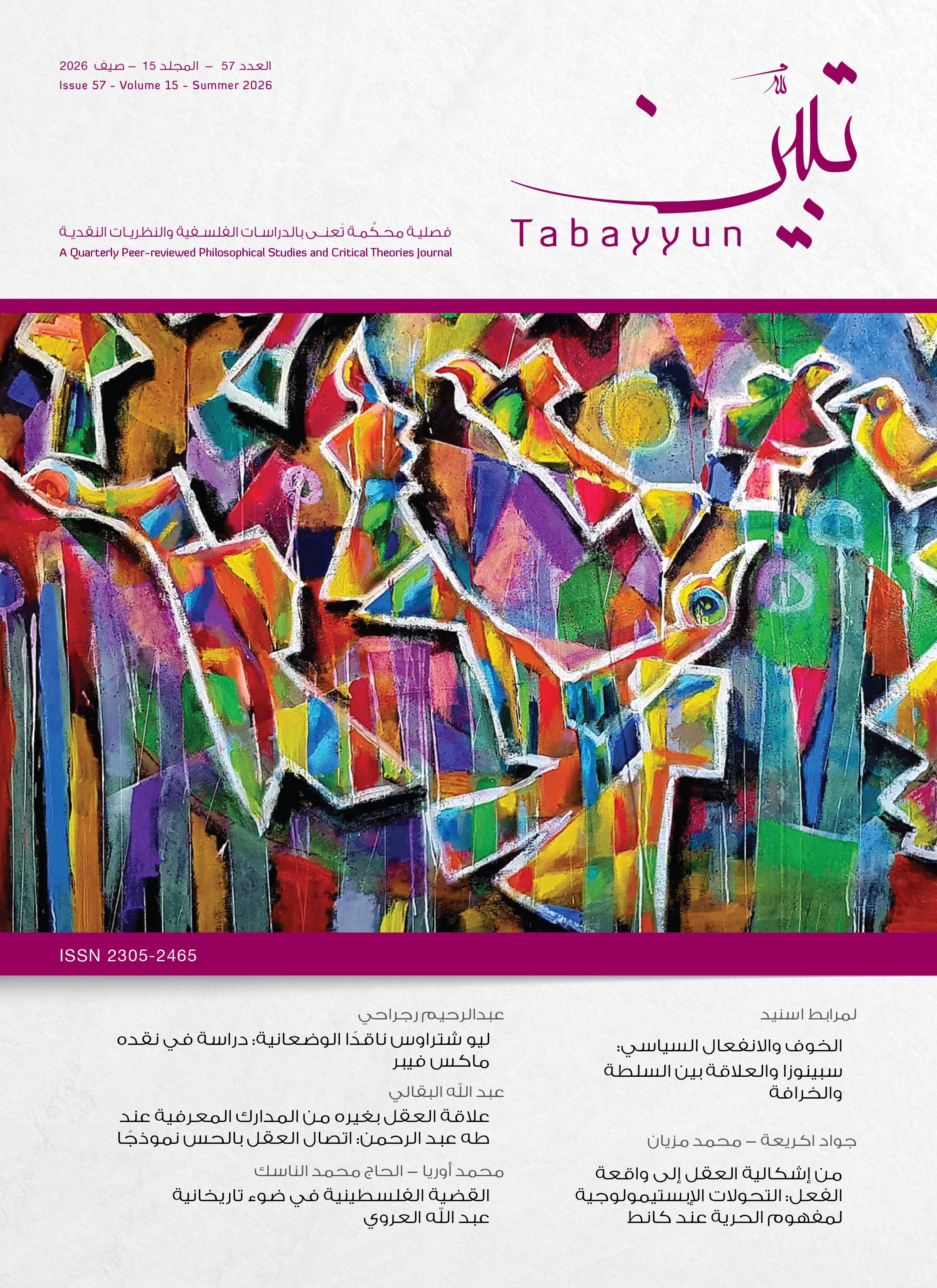
Omran for Social Sciences and HumanitiesIssue 57 of Tabayyun (2026) includes the following studies and articles: “Fear and Political Emotion: Spinoza and the Relationship between Authority and Superstition” (Lemrabott Sneid); “From the Problem of Reason to the Fact of Action: Epistemological Shifts in Kant’s Concept of Freedom” (Jaouad Gria, Mohamed Meziane); “Leo Strauss on Max Weber: His Critique of Positivism” (Abderrahim Rajrahi); “Taha Abdurrahman’s Account of the Connection between Reason and Sense Perception” (Abdellah Bakkali); “The Palestine Question and Abdallah Laroui's Historicism” (El-Hajj Mohamed al-Nassek, Mohamed Ourya); “Abdallah Laroui and Western Culture: Marx and Montesquieu as Pathways to Overcoming Historical Delay” (Soufian EL Barrak); “How Is This Paper Philosophy?” (Kristie Dotson); “The Concept of African Cultural Authenticity: Problematic and Methodological Issues and Other Topics” (Mujahid Eldouma); “The Political in the Ethics of Emmanuel Levinas” (Omar Badri); “Featured Books” (Editorial Board of Tabayyun).
Tabayyunصدر العدد 10 من دورية "استشراف للدراسات المستقبلية"، ويتضمّن الدراسات والمقالات الآتية: "استشراف الطاقة النووية المدنية في الدول العربية في أفق 2040: الجاهزية والمفاضلة بين الخيارات وآفاق التكامل الإقليمي" (موزة بنت محمد الربان)؛ "سيناريوهات التسرب النووي في منطقة الخليج العربي: المخاطر وسبل الوقاية والتعامل معها" (عثمان البهالي، محمد حسن الحجي)؛ "الذكاء الاصطناعي وحروب المستقبل: هل انتهى عصر الردع النووي؟" (عبد الصمد فاضل)؛ "الردع النووي الرمزي في الشرق الأوسط: السيناريوهات الاستراتيجية والتوازنات الإقليمية في أفق 2035" (الدانه عبد الله العماري)؛ "استشراف مستقبلات الطاقة النووية: أربعة مشاهد مستقبلية، عالميًا وعربيًا" (هيئة دورية استشراف للدراسات المستقبلية)؛ "مستقبل الطاقة النووية في سياق السياسات المناخية: السرديات المتنافسة والسيناريوهات الممكنة" (الحسين شكراني، محمد جواد مالزي)؛ "الطريق نحو عصر جديد للطاقة النووية" (وكالة الطاقة الدولية)؛ "سيناريو للحرب النووية" (نجاح عبد الحليم)؛ "النهج النظامي المتكامل في مستقبل الطاقة النووية" (هيئة دورية استشراف للدراسات المستقبلية)؛ "مستقبل البحث العلمي والابتكار في سلطنة عُمان: في ضوء الرؤية المستقبلية" (يوسف بن حمد البلوشي)؛ "تأثيرات الذكاء الاصطناعي 2025-2040: توليف استشرافي قائم على قرائن الاقتصاد السياسي والأنظمة الاجتماعية والتقنية والحوكمة الديمقراطية" (أحمد قاسم حسين)؛ "نحو عالم أكثر مساواة في المستقبل: على الأقل جغرافيًا" (مهدي الأورابي)؛ "الطاقة النووية في الفضاء: رؤية استشرافية (2025-2050)" (هيئة دورية استشراف للدراسات المستقبلية).
Istishraf for Future Studies
This paper draws on examples from the volatile history of Palestine under the British Mandate (1919-1948) to show how the political legacy of Palestine’s colonization has formed the basis, in part, of “criminal law” and how this was used as a tool in building colonial rule in Palestine. In the wake of the Buraq (Wailing Wall) Revolt in 1929, the British introduced a new legal process in an effort to preserve their control of Palestine, and quell Arab resistance. Barakat explains how the British constructed a system of laws and legal procedures during their colonial tenure that were both reactionary and foundational both within the context of British presence in Palestine and in how their relatively short colonial rule has resonated well beyond its historic tenure. By providing a close reading of the British methods and procedures that, at the time, were part of a concerted effort to control a strategic colonial outpost, Barakat shows how the law was manipulated as a means of control, which subsequently contributed to the ultimate failure of their rule. In an effort to suppress a national movement, the British manipulated their own version of a localized judicial system, to create a criminalizing process that is still used as one of the primary means of controlling the Palestinian Arab population nearly a century later.
This paper stresses that surveillance played a key role in re-conceptualizing politics and the public sphere in the Ottoman Empire. Kirli maintains that notions of “public” and “public opinion” were formed through a series of governmental practices that redefined politics in the second quarter of the 19th century. In doing so, the author resists employing conventional antagonistic conceptualizations of state and society and reductive notions of public and public opinion as merely sociological referents that emerged despite and against the state. Kirli details how public and public opinion were engineered by way of two examples. First, he traces the shifts in public opinion that coincided with the establishment of surveillance, using a set of informant reports generated by the Ottoman government in the 1840s. Second, he highlights the symbolic, though consequential, meaning of an unprecedented practice in courtly behavior (i.e., the sultan's public appearance). These new surveillance practices reflected a new form of governing based on the notion that the population is not a vague entity, but one that is knowable. Making the population legible was at once a process of inscription that required a reconfiguration of power relations, and an inevitable opening up of a new space for communication between the ruler and the ruled. This paper seeks to demonstrate that the formation of the public sphere and the surveillance of the population were inextricably linked.
Book Title: The Quest for Prosperity: How Developing Economies Can Take Off Author: Justin Yifu Lin Place of publication: Princeton, NJ Publisher: Princeton University Press Date of publication: 2012 Number of pages: 322
This paper is premised on a central hypothesis that argues the processes of surveillance and control in the colonial and post-colonial state are related to the growth of the state apparatus and its ideological discourse, as well as to the structuring of its elites in accordance with an externalist model of modernity that emerged in the periphery of the capitalist world. Within the framework of this hypothesis, Zayid used historical data and literature analysis to reveal the manner in which the processes of surveillance became institutionalized in the modern Egyptian state (the era of colonialism and its aftermath). Egypt’s methods of direct surveillance were transformed into institutions whose functions became increasingly intricate as the state structure became more complex and opposition to the existing political regimes grew. At the same time, these institutions came to increasingly rely on the symbolic power of the state and its agencies of surveillance and control, applying violence to broader social circles, making it an indirect tool to subdue and control individuals. The paper investigates the significance of surveillance mechanisms and control in terms of the formation of the political elites, the type of discourse adopted by these elites, and the inherent contradiction in the roles that they fulfill. Implicitly, the paper also reveals the significance of surveillance mechanisms and control in relation to the making of a national state during and after the colonial era and, more specifically, the fragile nature of this construction, devoid of a sturdy economy or real plans for development.
يقدم زياد منى في هذه الورقة مجموعة من التقديمات للكتب الصادرة حديثًا وهي (عدالة المنتصر – من نورمبرغ إلى بغداد، تاريخ الديمقراطية: تأويل ماركسي، فهم الظلال: الاستعمال المنحرف للاستخبارات، الشرق الأقرب: الألفية الأميركية والإرساليات إلى الشرق الأوسط، انحدار الإمبراطورية البريطانية وسقوطها (1781 – 1997)، خط في الرمال: بريطانيا وفرنسا والصراع الذي شكّل الشرق الأوسط).
الكتاب : الثورة السورية الوطنية وتنامي القومية العربية الكاتب : مايكل برفنس ترجمة : وسام دودار مكان النشر : بيروت الناشر : دار قدمس تاريخ النشر: 2013 عدد الصفحات: 340
At the heart of al-Hubayyeb’s analysis is the fact that Tunisia’s state crisis in the current transitional phase can be understood by analyzing Tunisian politicians’ ideological visions. On this basis, the study attempts to apply a comparative critical analysis of the ideological concepts and visions of Tunisia’s main political actors. The paper investigates the Tunisian state’s representation in the wake of its independence in Tunisia’s contemporary ideological context, explaining how the notion of a national state was excluded. It further analyzes the concept of revolution against this state and the representation of the January 14, 2011 event in the discourse of the main political actors on the Tunisian scene today. Al-Hubayyeb offers a thorough investigation into the links between the Tunisian crisis and Tunisians’ different ideologies and visions of Tunisia post-independence, the revolution against it, and the meaning of democratic transition.
This study investigates the manner in which the Arab citizen turned to the Internet during the Arab Spring as means for defying surveillance mechanisms that were put in place by the region’s despotic regimes. Khabash accentuates the fact that the success of the Arab Spring in bringing down regimes was partially due to these regimes’ inability to update and develop their tools and strategies for surveillance and control. Furthermore, social media networks and digital chat rooms have provided Internet users with a range of possibilities that do not exist in daily life, including the possibility to mask one’s identity, hiding their location, taking time to react, and receiving information in a direct unmediated manner. This has allowed Internet activists to not only bypass methods of surveillance and control that are employed by the existing authority, but also have enough courage to discuss taboo subjects that could not be broached in daily life.








