









Hikama: Issue 013 is out
Issue 13 of Hikama (2026) includes the following studies and articles: “Silence or Silencing?
HikamaJournals platform of the Arab Center for Research and Policy Studies.

Issue 13 of Hikama (2026) includes the following studies and articles: “Silence or Silencing?
HikamaIssue 21 of Almuntaqa (2026) includes the following studies and articles: “Editor's Note”; “Two Perspectives on the “Us” and Postmodern Thought” (Azmi Bishara); “Sudanese Peace Agreements (1972-2020): The Legacy of State Formation and the Challenges of Sustainability” (Ahmed Ibrahim Abushouk); “Public Right or Economic Commodity?
AlmuntaqaIssue 24 of Ostour for Historical Studies (2026) includes the following studies and articles: ““Styles” of Tunisian Historical Writing and Epistemic and Methodological Turns in the Modern and Contemporary Periods” (Abdelhamid Hénia); “Writing the General History of Tunisia over a Century: Changes and Challenges (1918-2019)” (Mohamed Lazhar Gharbi); “Repercussions of the Ottoman – Russian War (1768–1774) on the Political Situations in Mount Lebanon and the Coast during the Reign of Emir Yusuf Shihab” (Bassem Marwan Fleifel); “Kenitra from the Village to the Douar: The Expansion of the Urban Environment and the Emergence of the Moroccan Proletariat (1912 - 1975)” (Saïd El Bouzidi); “Urban Development of Jerusalem under Jordanian Rule: Narrating the Jerusalem International Airport, 1948-1967” (Mansour Nasasra); “Agricultural Modernization in Independent Morocco: Operation Plow (1957-1962)” (Brahim Aitizzy); “Microstoria” (Jacques Revel); “Moreno Cirillo's Journey to Southern Morocco: A Study of Mentalities, Representations, and Motivations” (Lacen Idbrahim, Bouzid Laghla); “Tunisia: From the Makhzen to the Modern State – Revisiting Mohamed-Salah Mzali's Intellectual Journey” (Khalid Jeddi); “A Workshop on Disseminating Historical Knowledge: A Reading of Fragments d'histoire marocaine: Société et figures du pouvoir by Abdelahad Sebti” (Hamid Titaou); “Gaza Faces History” (Abdelmajid Skhairi).
Ostour for Historical StudiesIssue 56 of Omran for Social Sciences and Humanities (Spring 2026) includes the following studies and articles: “Post-Independence Algerian Protest Movements: Rupture and Continuity” (Nacer Djabi); “The University as a Field of Struggle: Student Protests in Tunisia and Egypt (1968-1973)” (Adnan ElAmine); “Awareness of Otherness between Religion and Utility: Moroccans’ Representations of Sub-Saharan African Migrants” (Aziz Mechouat, Mehdi Jaafar); “When the Sociologist Wears the Historian’s Cloak: Uses of History in Khaldoun Al-Naqeeb’s Analysis of Gulf and Arabian Peninsula Societies” (Abdulrahman Alebrahim); “War by Another Means: The Impasse of Gaza’s Reconstruction After Genocide” (Wadee Alarabeed); “The Teacher in New Sociologies of Education” (Mohammed El Idrissi); “The Wet and the Dry: Traditional Irrigation in Bali and Morocco” (Clifford Geertz); “Current Ecological Trends: An Exercise in Classification and Typology” (Mohamed Hilal Elhassani); “Homo Numericus: The Coming “Civilization”” (Yassine Atana); “Featured Books” (Omran Editorial Board).
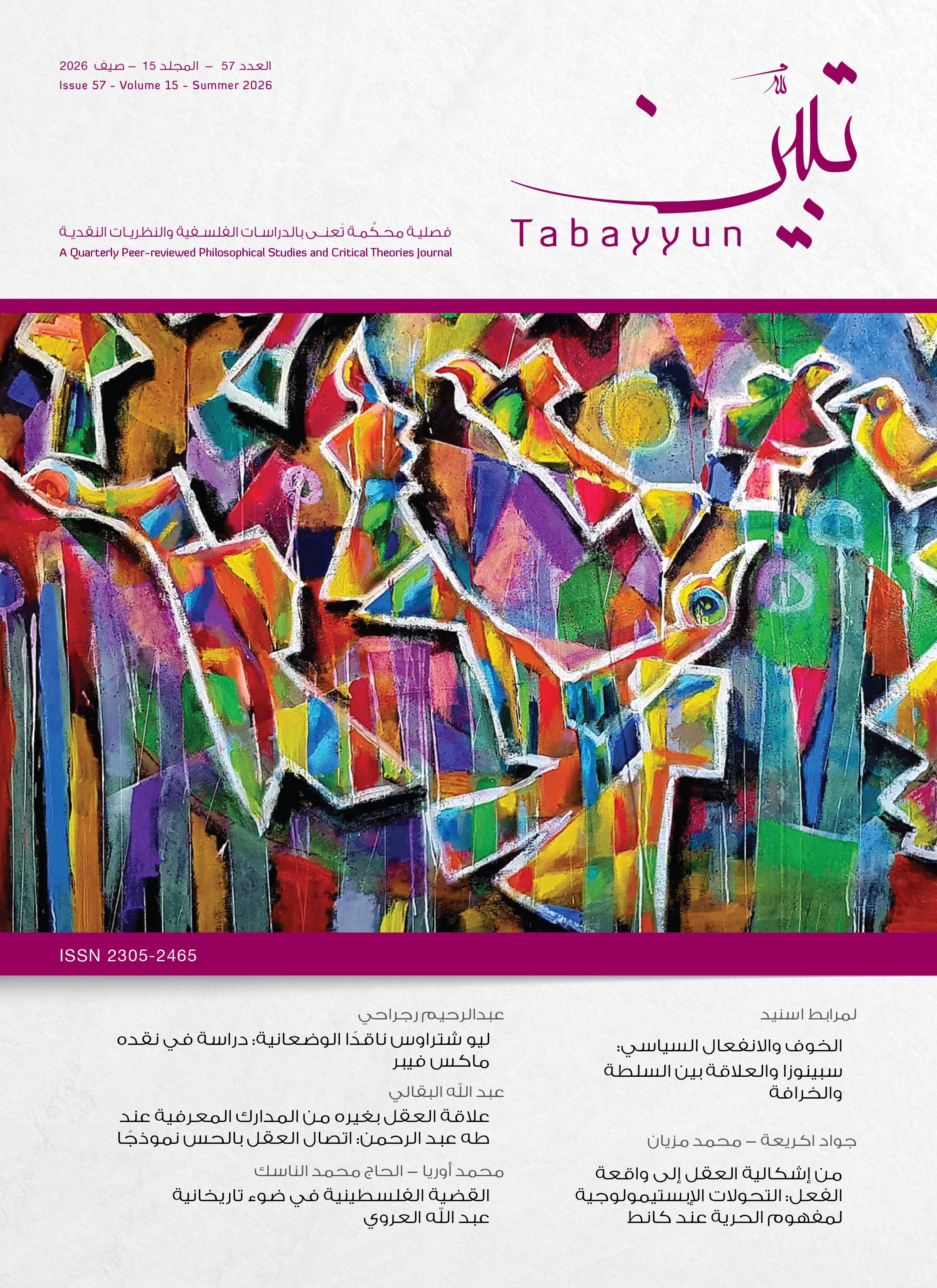
Omran for Social Sciences and HumanitiesIssue 57 of Tabayyun (2026) includes the following studies and articles: “Fear and Political Emotion: Spinoza and the Relationship between Authority and Superstition” (Lemrabott Sneid); “From the Problem of Reason to the Fact of Action: Epistemological Shifts in Kant’s Concept of Freedom” (Jaouad Gria, Mohamed Meziane); “Leo Strauss on Max Weber: His Critique of Positivism” (Abderrahim Rajrahi); “Taha Abdurrahman’s Account of the Connection between Reason and Sense Perception” (Abdellah Bakkali); “The Palestine Question and Abdallah Laroui's Historicism” (El-Hajj Mohamed al-Nassek, Mohamed Ourya); “Abdallah Laroui and Western Culture: Marx and Montesquieu as Pathways to Overcoming Historical Delay” (Soufian EL Barrak); “How Is This Paper Philosophy?” (Kristie Dotson); “The Concept of African Cultural Authenticity: Problematic and Methodological Issues and Other Topics” (Mujahid Eldouma); “The Political in the Ethics of Emmanuel Levinas” (Omar Badri); “Featured Books” (Editorial Board of Tabayyun).
Tabayyunصدر العدد 10 من دورية "استشراف للدراسات المستقبلية"، ويتضمّن الدراسات والمقالات الآتية: "استشراف الطاقة النووية المدنية في الدول العربية في أفق 2040: الجاهزية والمفاضلة بين الخيارات وآفاق التكامل الإقليمي" (موزة بنت محمد الربان)؛ "سيناريوهات التسرب النووي في منطقة الخليج العربي: المخاطر وسبل الوقاية والتعامل معها" (عثمان البهالي، محمد حسن الحجي)؛ "الذكاء الاصطناعي وحروب المستقبل: هل انتهى عصر الردع النووي؟" (عبد الصمد فاضل)؛ "الردع النووي الرمزي في الشرق الأوسط: السيناريوهات الاستراتيجية والتوازنات الإقليمية في أفق 2035" (الدانه عبد الله العماري)؛ "استشراف مستقبلات الطاقة النووية: أربعة مشاهد مستقبلية، عالميًا وعربيًا" (هيئة دورية استشراف للدراسات المستقبلية)؛ "مستقبل الطاقة النووية في سياق السياسات المناخية: السرديات المتنافسة والسيناريوهات الممكنة" (الحسين شكراني، محمد جواد مالزي)؛ "الطريق نحو عصر جديد للطاقة النووية" (وكالة الطاقة الدولية)؛ "سيناريو للحرب النووية" (نجاح عبد الحليم)؛ "النهج النظامي المتكامل في مستقبل الطاقة النووية" (هيئة دورية استشراف للدراسات المستقبلية)؛ "مستقبل البحث العلمي والابتكار في سلطنة عُمان: في ضوء الرؤية المستقبلية" (يوسف بن حمد البلوشي)؛ "تأثيرات الذكاء الاصطناعي 2025-2040: توليف استشرافي قائم على قرائن الاقتصاد السياسي والأنظمة الاجتماعية والتقنية والحوكمة الديمقراطية" (أحمد قاسم حسين)؛ "نحو عالم أكثر مساواة في المستقبل: على الأقل جغرافيًا" (مهدي الأورابي)؛ "الطاقة النووية في الفضاء: رؤية استشرافية (2025-2050)" (هيئة دورية استشراف للدراسات المستقبلية).
Istishraf for Future Studies
The 1923 Egyptian constitution was the first democratic constitution in Egypt, the first pillar of the nascent parliamentary system, and an important step on the path toward political and constitutional consolidation—in short, the 1923 constitution ushered Egypt into a new historical era. This paper focuses on the issue of representation of minorities in this pioneering constitutional experiment. The question will be treated within the context of the formation of Egyptian nationalism following the 1919 Revolution, which replaced Islamism. This process culminated in the 1923 constitution, which guaranteed equal rights to all Egyptians, regardless of their religion, gender, and mother tongue, while simultaneously guaranteeing the freedom of belief and the free practice of religious rituals. This process removed the religious notion of “minorities” from the Egyptian political lexicon and replaced it with the notion of “political or economic minorities”.
This study is rooted in the multiple and varied contexts in which the Ottomans were compelled to adopt the Tanzimat, alluding to the series of reforms adopted by the Ottoman Empire in the 19th century and that later gave rise to a constitution. These reforms came about as a result of the collision with expansionist and competitive forms of capitalism, a growing awareness among local elites on the importance of reforms and the tensions borne out of the diversity and complexity of their local composition. This study seeks to describe these reforms in terms of what they strived to achieve—a Western concept of citizenship represented in the formation of a nation-state, which implied the rise of civil society, human rights, and the rights of citizenship—and what was prevalent at the time of the Ottoman Empire—a system that conceptually embodied the idea of a state founded on a dominant, over-arching social group (or social solidarity – asabiyah) in a community composed of multiple clans.
This study begins with a cursory look at the Arab scene, focusing on the ongoing constitutional debates and its controversies gripping the region today. In examining the current state of affairs in the region, the author takes the reader on a journey through modern Arab constitutional history that begins with the late Ottoman era and ends in present day. This historical narrative aims at exploring the record of constitutional reforms, the structuring of political systems, and the extent to which the notion of citizenship is rooted in the respective Arab countries. This narrative goes beyond the historical roots of Arab constitutional thought, and examines Arab political thought – based on the premise that it was the region’s political culture that fostered constitutional thought. To this end, the author explores the predominance of Islamic culture, the new issues and challenges that were introduced by globalization, the impact of nationalism in the region and the conflict with Israel.
During its three sessions held in 1919 and 1920, the Syrian Congress constitutionally represented the population of Syria, giving voice to the socio-political changes then underway. Political parties and blocs were formed within the parliament, which later came to be called “internal” formations. Although they took form within the context of the parliament’s internal dynamics, they were also deeply tied to the socio-political movements active outside of parliament. Syria’s first constitution, set out by the founding fathers of the Modern Arab Nationalist movement, had envisaged such events and given a structured written expression to the political and legal thinking of the movement. The discussions within the Congress centered on the controversial articles within the constitution: the relationship between religion and the state; women’s issues; citizenship and identity; and the relationship between the state’s national character and administrative decentralization. In his analysis, the author argues how as a document, the Constitution proved to be ahead of its time on issues which would be at the heart of later discussions emerging not only in subsequent Syrian constitutional assemblies, but also in the constitutional development of Arab states in general. It also had an impact on the views of political and social elites. In this way, the significance of the first Syrian constitution goes beyond its historical importance.
There is a new industry alongside the others by means of which the ruling class in America controls US society and many societies around the world to varying degrees and in various forms. This is the pornography industry that ranges from commercials to porn films and beyond. The rising sex fever and its industry and commerce has been the subject of many studies and much critique in the United States and globally in the aim of raising awareness about the risks of slipping into this swamp and becoming submerged.
The revolutions of the Arab Spring have incited key intellectual and political movements in the Arab world, deeply influencing the state of Arab affairs and prompting these movements, including that of Islamists, to re-invent themselves and revise their own ideologies and perceptions. Democracy, then, presents a key starting point for reexamination. It is in democracy that the demands raised by the revolutionary movement coalesce and take the form of tangible, political, rights-based demands, giving birth to democratic values and their translation into concrete political action. This new regional landscape presents the Islamists with an opportunity to move from an instrumental definition of democracy (one defined by the instruments of elections, political pluralism, and peaceful transitions of power) to a more fundamental, philosophical understanding of democracy (defined by concepts of liberty, secular law and equality based on citizenship). The author here presents the case of the Moroccan Justice and Development Party and exemplifies through this case study the willingness of Islamists to renew their beliefs and revise Islamic jurisprudence.








