









Hikama: Issue 013 is out
Issue 13 of Hikama (2026) includes the following studies and articles: “Silence or Silencing?
HikamaJournals platform of the Arab Center for Research and Policy Studies.

Issue 13 of Hikama (2026) includes the following studies and articles: “Silence or Silencing?
HikamaIssue 21 of Almuntaqa (2026) includes the following studies and articles: “Editor's Note”; “Two Perspectives on the “Us” and Postmodern Thought” (Azmi Bishara); “Sudanese Peace Agreements (1972-2020): The Legacy of State Formation and the Challenges of Sustainability” (Ahmed Ibrahim Abushouk); “Public Right or Economic Commodity?
AlmuntaqaIssue 24 of Ostour for Historical Studies (2026) includes the following studies and articles: ““Styles” of Tunisian Historical Writing and Epistemic and Methodological Turns in the Modern and Contemporary Periods” (Abdelhamid Hénia); “Writing the General History of Tunisia over a Century: Changes and Challenges (1918-2019)” (Mohamed Lazhar Gharbi); “Repercussions of the Ottoman – Russian War (1768–1774) on the Political Situations in Mount Lebanon and the Coast during the Reign of Emir Yusuf Shihab” (Bassem Marwan Fleifel); “Kenitra from the Village to the Douar: The Expansion of the Urban Environment and the Emergence of the Moroccan Proletariat (1912 - 1975)” (Saïd El Bouzidi); “Urban Development of Jerusalem under Jordanian Rule: Narrating the Jerusalem International Airport, 1948-1967” (Mansour Nasasra); “Agricultural Modernization in Independent Morocco: Operation Plow (1957-1962)” (Brahim Aitizzy); “Microstoria” (Jacques Revel); “Moreno Cirillo's Journey to Southern Morocco: A Study of Mentalities, Representations, and Motivations” (Lacen Idbrahim, Bouzid Laghla); “Tunisia: From the Makhzen to the Modern State – Revisiting Mohamed-Salah Mzali's Intellectual Journey” (Khalid Jeddi); “A Workshop on Disseminating Historical Knowledge: A Reading of Fragments d'histoire marocaine: Société et figures du pouvoir by Abdelahad Sebti” (Hamid Titaou); “Gaza Faces History” (Abdelmajid Skhairi).
Ostour for Historical StudiesIssue 56 of Omran for Social Sciences and Humanities (Spring 2026) includes the following studies and articles: “Post-Independence Algerian Protest Movements: Rupture and Continuity” (Nacer Djabi); “The University as a Field of Struggle: Student Protests in Tunisia and Egypt (1968-1973)” (Adnan ElAmine); “Awareness of Otherness between Religion and Utility: Moroccans’ Representations of Sub-Saharan African Migrants” (Aziz Mechouat, Mehdi Jaafar); “When the Sociologist Wears the Historian’s Cloak: Uses of History in Khaldoun Al-Naqeeb’s Analysis of Gulf and Arabian Peninsula Societies” (Abdulrahman Alebrahim); “War by Another Means: The Impasse of Gaza’s Reconstruction After Genocide” (Wadee Alarabeed); “The Teacher in New Sociologies of Education” (Mohammed El Idrissi); “The Wet and the Dry: Traditional Irrigation in Bali and Morocco” (Clifford Geertz); “Current Ecological Trends: An Exercise in Classification and Typology” (Mohamed Hilal Elhassani); “Homo Numericus: The Coming “Civilization”” (Yassine Atana); “Featured Books” (Omran Editorial Board).
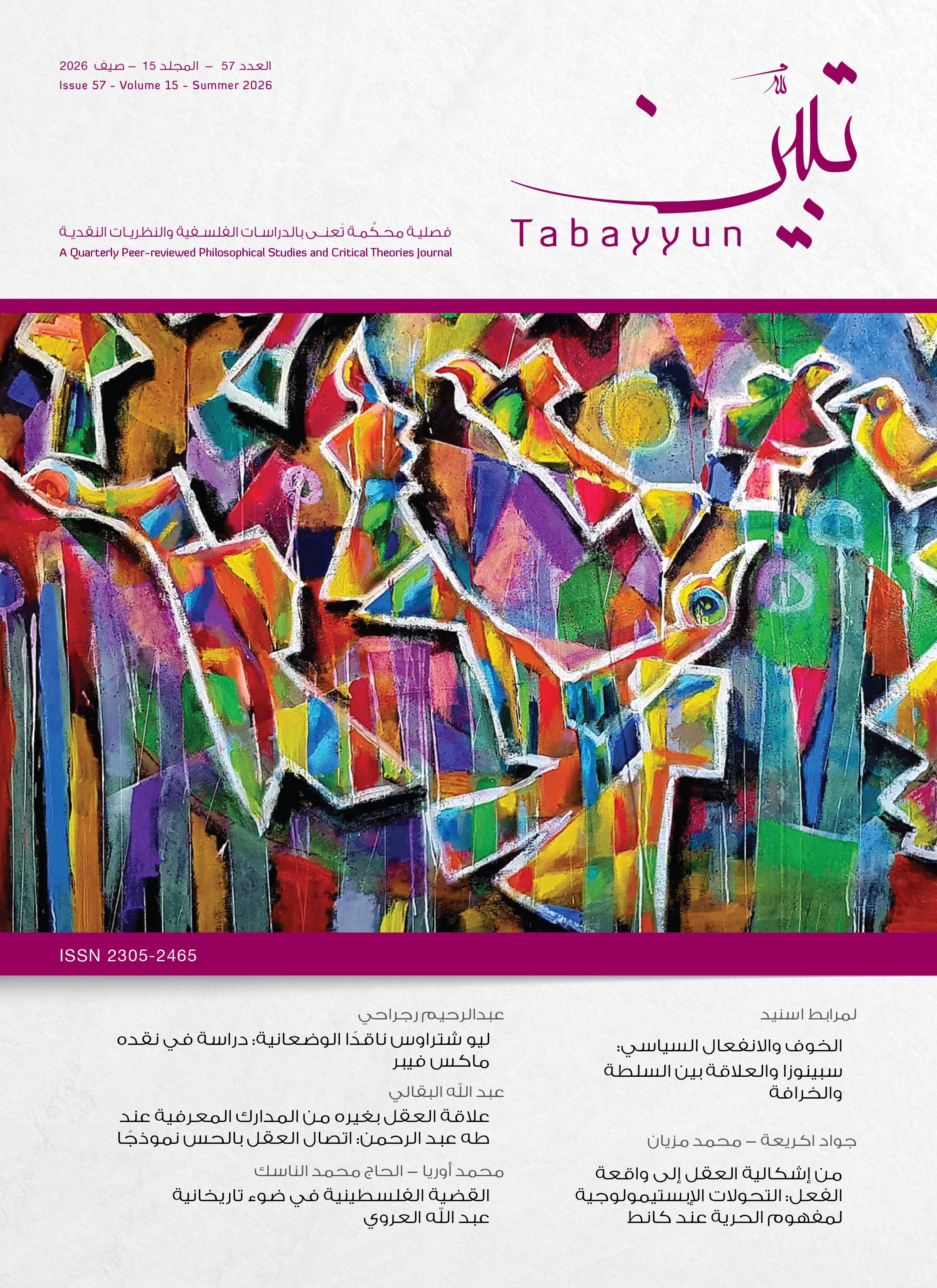
Omran for Social Sciences and HumanitiesIssue 57 of Tabayyun (2026) includes the following studies and articles: “Fear and Political Emotion: Spinoza and the Relationship between Authority and Superstition” (Lemrabott Sneid); “From the Problem of Reason to the Fact of Action: Epistemological Shifts in Kant’s Concept of Freedom” (Jaouad Gria, Mohamed Meziane); “Leo Strauss on Max Weber: His Critique of Positivism” (Abderrahim Rajrahi); “Taha Abdurrahman’s Account of the Connection between Reason and Sense Perception” (Abdellah Bakkali); “The Palestine Question and Abdallah Laroui's Historicism” (El-Hajj Mohamed al-Nassek, Mohamed Ourya); “Abdallah Laroui and Western Culture: Marx and Montesquieu as Pathways to Overcoming Historical Delay” (Soufian EL Barrak); “How Is This Paper Philosophy?” (Kristie Dotson); “The Concept of African Cultural Authenticity: Problematic and Methodological Issues and Other Topics” (Mujahid Eldouma); “The Political in the Ethics of Emmanuel Levinas” (Omar Badri); “Featured Books” (Editorial Board of Tabayyun).
Tabayyunصدر العدد 10 من دورية "استشراف للدراسات المستقبلية"، ويتضمّن الدراسات والمقالات الآتية: "استشراف الطاقة النووية المدنية في الدول العربية في أفق 2040: الجاهزية والمفاضلة بين الخيارات وآفاق التكامل الإقليمي" (موزة بنت محمد الربان)؛ "سيناريوهات التسرب النووي في منطقة الخليج العربي: المخاطر وسبل الوقاية والتعامل معها" (عثمان البهالي، محمد حسن الحجي)؛ "الذكاء الاصطناعي وحروب المستقبل: هل انتهى عصر الردع النووي؟" (عبد الصمد فاضل)؛ "الردع النووي الرمزي في الشرق الأوسط: السيناريوهات الاستراتيجية والتوازنات الإقليمية في أفق 2035" (الدانه عبد الله العماري)؛ "استشراف مستقبلات الطاقة النووية: أربعة مشاهد مستقبلية، عالميًا وعربيًا" (هيئة دورية استشراف للدراسات المستقبلية)؛ "مستقبل الطاقة النووية في سياق السياسات المناخية: السرديات المتنافسة والسيناريوهات الممكنة" (الحسين شكراني، محمد جواد مالزي)؛ "الطريق نحو عصر جديد للطاقة النووية" (وكالة الطاقة الدولية)؛ "سيناريو للحرب النووية" (نجاح عبد الحليم)؛ "النهج النظامي المتكامل في مستقبل الطاقة النووية" (هيئة دورية استشراف للدراسات المستقبلية)؛ "مستقبل البحث العلمي والابتكار في سلطنة عُمان: في ضوء الرؤية المستقبلية" (يوسف بن حمد البلوشي)؛ "تأثيرات الذكاء الاصطناعي 2025-2040: توليف استشرافي قائم على قرائن الاقتصاد السياسي والأنظمة الاجتماعية والتقنية والحوكمة الديمقراطية" (أحمد قاسم حسين)؛ "نحو عالم أكثر مساواة في المستقبل: على الأقل جغرافيًا" (مهدي الأورابي)؛ "الطاقة النووية في الفضاء: رؤية استشرافية (2025-2050)" (هيئة دورية استشراف للدراسات المستقبلية).
Istishraf for Future Studies
Within the ongoing debate about deliberative democracy, Jürgen Habermas's arguments have gained prominence, not only in critiquing this new form of democratic practice but also in addressing the challenges it faces and the discussions it has sparked in contemporary political philosophy. The significance and centrality of Habermas' conceptualization necessitate a careful examination of the argument upon which it is based and the concept of deliberation it relies on. It is crucial to explore the content and limitations of this conceptualization to construct an objective assessment: Did Habermas present a viable conceptualization of deliberative democracy that could serve as a reliable alternative to the representational model? Does the deliberative approach, as formulated by Habermas, raise more challenges than the solutions it proposes? Why did the path which relies on consensus lead to the formulation of a philosophical justification for civil disobedience? To answer these questions, this paper briefly outlines the features of this conceptualization and then explores the challenges it faces, stemming from both its argumentative construction and its practical effectiveness, in an effort to make an objective evaluation.
The concept of total institution in the research of Erving Goffman (1922-1982) lacks the presence it deserves in the published Arabic literature, especially in studies related to institutions. Goffman provides a theoretical framework crucial for analyzing several modern institutions of similar nature and impact, manifested in social disintegration and rendering individuals submissive. In this context, this study approaches the concept of total institution, whether in its original form as described by Goffman or as defined in subsequent texts that criticized and developed the concept further. The study also seeks to understand the nature of the total institution, the forms of power within it, and how it leads to social disintegration, without neglecting the effectiveness of individual resistance to this process.
This paper examines the concept of Homo Sacer and its relationship to the state of exception in Giorgio Agamben's thought. The paper examines the term's transformations from theology to politics, and from ancient Roman law to the manifestations of their forms today. The research investigates a range of political concepts adjacent to this term, such as sovereign power, law, biopolitics, the state of exception, and naked life. Homo Sacer is a concept with multiple meanings, but interpreting it according to new contexts, dismantling its symbolic load and expanding it semantically produces several readings of the current political modernization that puts human life within a violent policy of a state that extends its sovereignty over life and death through cases of exception. This produces the naked life of a despised outcast, excluded from political and social participation in the name of law. This paper focuses on the theoretical conflict between the legal justification for state of exception as defined by Carl Schmitt, and its ambiguity, and the implications of its employment by both the authoritarian and democratic state, according to Giorgio Agamben. The contemporary relevance of this problem is evident in the fact that the state of exception is no longer temporary, but has rather become a permanent state or legal rule in most contemporary political systems.
The book 'The Poverty of Theory: Questions in Cultural Studies' discusses and questions the dominance of postmodern theories, or what is referred to as 'French Theory,' in cultural studies.
This paper deals with Praxis as the central paradigm in Richard Rorty's philosophy. Considering philosophy as praxis transforms the way we understand philosophy and draws our attention to literature that is more practical. Is truth the purpose of philosophy? How can philosophy as praxis and literary works contribute to the improvement of human condition? The study asserts that Richard Rorty was not able to justify his views on philosophy and literature, and develop a new value, irony, until he extricated the practical paradigm from its antithesis (the theoretical paradigm). By embodying the value of irony, philosophy and literature can fulfil their potential to disavow the theoretical and foundational paradigm, to become devoted to hope and to moral and social progress.
Book title: The Populist Century: History, Theory, Critique. Author: Pierre Rosanvallon. Translator: Muhammad Al-Rahmouni. Publisher: Doha/ Beirut: Arab Center for Research and Policy Studies. Date of Publication: 2022. Pages: 295.
This article sheds light on the problem of interpretation and its relationship to the event according to the Italian philosopher Giambattista Vico. It explores how a hermeneutic seed forms a constant starting point for the cognitive framework of humanistic philosophy. Vico elucidates how the "new science" in which "philology" and "philosophy" collaborate is the objective level in which the structure and movement of spontaneous human events are reflected. This in itself constitutes an interpretive event. Vico's work focuses on providing an interpretive discussion of truth concerning the "actual reality" by recognizing the nature of interpretation as a potentially poetic construction, as a playful possibility of insight into truth and the logic of its probability. The article seeks to discern the meaning of interpretation and reads Vico's contribution as a pivotal sign of the emergence of a hermeneutic form, resulting in a new form of rationality in understanding human history and thus establishing a hermeneutics of cosmic history.
In this study, the British philosopher Margaret Canovan analyses the enigmatic questions raised by the philosophical principles of liberal doctrine. Her discussion moves us from the familiar traditional "contradiction" between the liberal commitment to the Enlightenment and its conservative critics, to the worrying "convergence" between two traditions (the liberal and the conservative), both of which depend on useful illusions and myths that do not stand up to public scrutiny. Canovan begins her analysis with Roger Scruton's 1988 paper critiquing Liberalism in the name of community. He argued that liberal principles are inconsistent because they downplay the social loyalties necessary for social cohesion and without any justification take the vocabulary of individualism as a self-evident frame of reference. For her part, Canovan argues that this treatment was controversial and disturbing, because it drew attention to the fact that liberal values and principles might be considered weak ideals that need constant protection, especially if they are always the subject of free public debate.








